
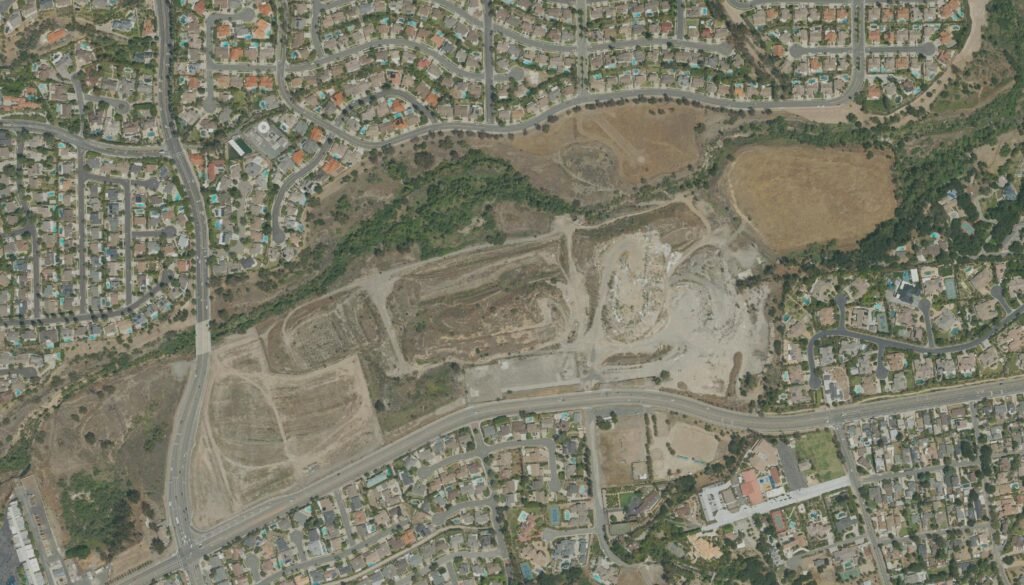
Orange’s plan for the former Sully-Miller quarry could eventually put nearly 68 acres into public hands. The deal also leaves the city with a substantial second job: deciding what to build there and how to pay for its care.
The distinction is written into the property transfer agreement presented to the City Council. Landify ECT Construction Corporation would prepare the land. Finished trails, landscaping, equestrian facilities and other amenities would be Orange’s responsibility.
The council approved the agreements Aug. 25, according to the city’s state-filed notice. This is a look at what those documents provide for, rather than an announcement that a park is opening.
What would change hands
The transaction covers approximately 67.7 acres at 6145 E. Santiago Canyon Road. Under the agreement, Landify would first acquire the property from Milan REI X, LLC, then conduct grading and an operation that uses clean soil and inert debris to shape the land for future open-space use.
Orange would take ownership after the required work and transfer conditions were satisfied. The attached grant-deed form calls for a permanent restriction allowing passive recreation, habitat restoration, trails and other non-intensive open-space uses.
That is a commitment about the land’s future use, not a finished trail plan. The publicly posted agreement leaves several exhibits—including the soils management plan, conceptual grading plan and project site plan—to be provided later.
No purchase price, but costs remain
The city’s staff report says Orange would pay no purchase price and would not fund Landify’s acquisition or grading operation. Section 6.5 of the transfer agreement nevertheless assigns Orange its own administrative costs and certain outside costs incurred while carrying out its oversight responsibilities.
At closing, Orange would pay the owner’s title-insurance premium, half the escrow fees and its own legal costs. Later, it would be responsible for maintaining the property and funding any public improvements. The staff report does not establish a price for those future amenities or ongoing care.
If the project stops making financial sense
Section 6.6 addresses a possibility that matters to the public: changes in regulations, soil availability or the economics of soil volumes and tipping fees could make the work commercially unviable in Landify’s reasonable judgment.
The agreement provides several possible responses. The parties could revise the plans or agree to end the deal. Orange could choose to accept the property before completion, or choose to compensate Landify to make the original work financially feasible. Those are options, not an automatic requirement that the city subsidize the project.
If no agreement is reached within the specified 10-day period after Landify’s written request, Landify could terminate. For a phase already started but unfinished, the document requires rough grading, placement of topsoil using material already on site, and reseeding.
Before each phase begins, Section 6.3 requires a deposit, bond or equivalent credit covering the estimated cost of that reclamation work. The stated measure is reclamation of the phase—not the cost of delivering a completed public park.
Conditions before Orange takes ownership
The transfer agreement requires environmental and geotechnical testing, applicable agency approvals, completion and certification of grading, acceptable title and environmental insurance. The city manager must independently verify and approve the city’s closing conditions; any waiver must be in writing.
A separate environmental liability agreement requires Milan to obtain pollution insurance with limits of at least $3 million per claim and $3 million overall. Its stated coverage period extends through Landify’s ownership and at least five years after Orange acquires the property, subject to a maximum of 10 years from issuance.
The document also allocates responsibility for uncovered third-party claims arising from each party’s acts or omissions during its ownership. These are contractual protections with conditions and limits; they do not establish that every possible future expense would be insured.
A larger creek corridor—and decisions still ahead
City staff connects the proposed transfer with about 14 acres preserved through the Chandler/Hurwitz effort and roughly 30.75 acres Orange accepted in January. Together, the three efforts would amount to approximately 112 acres if the new transfer is completed. The report cautions that the properties are not necessarily contiguous.
For residents, the next useful milestones are the operating and grading approvals, completed transfer documents, and public decisions about improvements and maintenance funding. The agreement ties closing to completion of grading and other conditions; it does not supply a calendar date when residents can start using a new park.
Reporting note: This article examines the agreements published with the Aug. 25 council item. Those copies contain blank execution dates and unfinished exhibits. They describe the approved framework, not proof that the property has transferred or that all permits have been issued.